
Forklift Battery Charger Selection & Common Charger Configurations
Battery voltage, capacity and chemistry describe the battery. Charger current, charging profile and AC supply describe a different set of requirements. Compare both sides before choosing a charger.
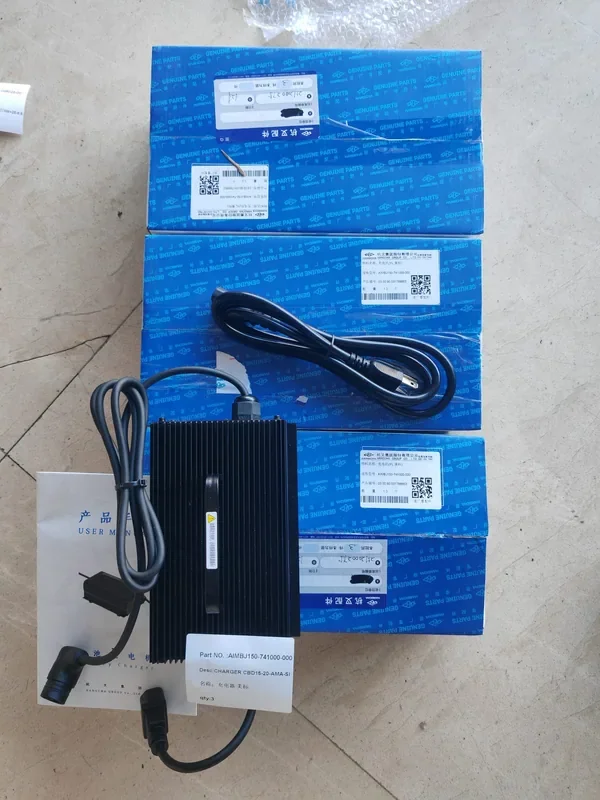
AIMBJ150-741000-000 charger reference. Match the battery, connector and charging profile before ordering.
Ah describes capacity. A describes charging current.
An 80 V, 404 Ah battery is not a 404 A charging requirement. A request for 200 A still needs the battery manufacturer’s permitted charge current, BMS limits, connector rating and approved charging profile.
Dividing amp-hours to replenish by charging amps gives only an ideal estimate. Tapering, balancing, losses, temperature and charging interruptions mean it is not a guaranteed charging time.
Documented charger configurations
| Example | Nominal battery / current | Chemistry and AC input | Still needs matching |
|---|---|---|---|
| Delta-Q IC1200, 24 V variant | 24 V; maximum 50 A; 1,200 W | 85–270 VAC; lead-acid or lithium with the appropriate profile | Exact battery profile, connector and optional CAN configuration |
| Delta-Q IC1200, 36 V variant | 36 V; maximum 33.3 A; 1,200 W | 85–270 VAC; lead-acid or lithium with the appropriate profile | Do not transfer the 24 V variant’s output current to this version |
| Delta-Q IC1200, 48 V variant | 48 V; maximum 25 A; 1,200 W | 85–270 VAC; lead-acid or lithium with the appropriate profile | Full order code, capacity suitability, charge profile and battery/BMS approval |
| EnerSys NexSys+ — 72 V class | Exact output current: confirm selected model | Input supply, chemistry and approved battery capacity: confirm selected model | Use the full order code and manufacturer application documentation. |
| EnerSys NexSys+ — 80 V class | Exact output current: confirm selected model | Input supply, chemistry and approved battery capacity: confirm selected model | Do not assume the 72 V and 80 V configurations share an output profile. |
| EnerSys NexSys+ — 96 V class | Exact output current: confirm selected model | Input supply, chemistry and approved battery capacity: confirm selected model | Confirm site AC supply and exact battery requirements. |
An 80 V / 200 A label is only part of the match
The D80V-200A-LI-423 reference shown here identifies an 80 V / 200 A lithium charger example. It does not prove a pairing with a particular 404 Ah battery, a HELI truck or a BMS protocol.
Keep the full charger model alongside the battery nameplate and the available AC supply. Do not choose a connector from a distant exterior photo.
Existing 80 V / 200 A lithium charger reference; battery pairing is not confirmed.
Compare the battery, charger and installation
Battery voltage and chemistry define the charging requirement first. Use capacity, the permitted charge current and the charging window to narrow the charger choice. Before accepting an order, reconcile the full charger version with the connector and polarity, site AC supply, charging profile and battery/BMS communication; an Ah figure or an output-current label cannot close those checks.
| Battery | Charger / site | Why it matters |
|---|---|---|
| Nominal voltage and chemistry | Output voltage profile | Nominal voltage alone does not define the required charging curve |
| Capacity Ah and permitted charge current | Output A and charging window | Capacity is not current; charging speed is limited by the battery |
| BMS make, model and firmware | CAN protocol or approved non-CAN control | A CAN connector alone does not establish compatible messages |
| Connector face, keying and cable rating | Connector, polarity and rated current | Similar housings can have different contacts, ratings or wiring |
| Use and temperature conditions | Cooling, environment and AC supply | Provide AC voltage, phase and frequency; do not assume an industrial socket is suitable |
AIMBJ150-741000-000 needs its own battery check
AIMBJ150-741000-000 is an existing Hangcha charger reference. The product page and label are useful identification evidence; they are not an alternative to checking the battery.
Exact charger reference; confirm battery and AC requirements.
Send what is available
Battery nameplate, old charger label and connector photos are the most useful starting information. Add AC voltage, phase and frequency if known. If current is unknown, give the time available between shifts. You can send an inquiry without completing a technical questionnaire.
Ask about the part you need
A part number is optional. Send it if you have it, or choose the identification route that fits your information. No technical field below is required.
Related parts and selection information
Technical references
Manufacturer examples are not confirmed Authpart stock or vehicle fitment. Check the current documentation for the exact model and revision.
More help choosing the correct part
Forklift connectors and plugs: power, signal and mechanical keying