Forklift DC-DC Converter Selection: Input Range, Output and Isolation
Start with the actual battery input range and the voltage required by the accessories. Then compare output current, isolation, enable wiring and mounting. “48 V to 12 V” alone leaves important differences unresolved.
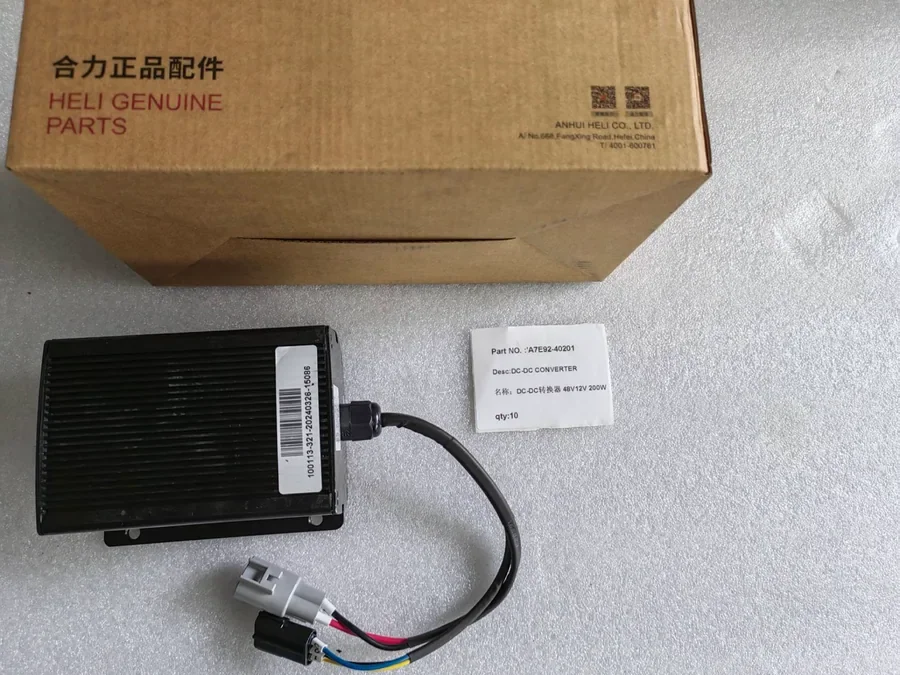
A7E92-40201 converter reference labeled 48 V to 12 V and 200 W. Isolation, pinout and operating input range remain to confirm.
A known local reference: A7E92-40201
This is a useful starting reference when the old part carries the same number. Confirm the complete connector arrangement and mounting before treating it as a replacement. We do not convert its 200 W description into an unverified continuous output-current rating.
The photographed reference card identifies A7E92-40201, 48 V to 12 V and 200 W. The complete housing and connectors are shown; the card does not establish an operating input range, isolation rating or pinout. View full photo
Published examples show why the voltage wording matters
The 1420 example changes its available operating current with the input band. The 1450 separates “Absolute” and “Nominal” output versions, so two products described informally as 12 V can regulate differently. Use the exact model and datasheet revision when checking the accessory voltage tolerance.
| Model / version | Continuous input range | Published output detail |
|---|---|---|
| 1420, 12.4 V version | 18–106 V DC | 16 A at 18–27 V input; 24 A at 27–106 V input |
| 1450, 12 V Absolute | 24–120 V DC | 12 V setpoint; 41.7 A |
| 1450, 12 V Nominal | 24–120 V DC | 14 V at no load; 13.5 V at full load; 37 A |
| 1450, 24 V Absolute | 24–120 V DC | 24 V setpoint; 20.8 A |
| 1450, 24 V Nominal | 24–120 V DC | 28 V at no load; 27 V at full load; 18.5 A |
Build an accessory-load list before choosing capacity
List the displays, lights, controls and other loads actually connected to the converter. Record each device’s permitted supply voltage and current information, including any documented startup requirement. Keep future additions separate from the present load; a converter label is not evidence of the truck’s total accessory demand.
Where a device rating is missing, send its label or part number instead of estimating. The selected converter must also be checked against the required operating temperature and cooling arrangement.
Isolation, enable and return wiring need their own check
Curtis documents isolated input/output on both examples. Its 1420 12.4 V version lists a maximum input-to-output isolation voltage of 2000 V DC; the 1450 lists 1.5 kV. These are manufacturer isolation specifications, not operating-voltage instructions. Enable is ordering-version dependent: the 1420 identifies 1420E-0007/-0008/-0009, while the 1450 ordering code separates no-enable and enable versions. These data do not establish A7E92-40201 isolation or wiring.
| Check | Useful evidence | Do not assume |
|---|---|---|
| Input limits | Battery label plus converter input specification | Nominal battery voltage equals the full operating range |
| Output and load | Exact output version and accessory ratings | All “12 V” outputs have the same regulation |
| Isolation / return | Manufacturer specification and wiring diagram | An aluminium case proves isolation or a common negative |
| Enable or key-switch input | Full ordering code and connector pinout | A spare wire can be connected to battery positive |
| Connector and protection | Connector face, keying, cable and fuse references | Matching wire colours establish identical pin functions |
| Installation | Hole spacing, overall envelope and heat-sink clearance | A higher power label alone makes a suitable upgrade |
Prepare a converter request with the evidence you have
Send the old converter number, battery voltage, required output, accessory-load information and photos of every connector. Add the truck model and serial number if the converter label is unreadable. Ask for confirmation of any remaining isolation, enable, pinout or cooling requirement before ordering.
Ask about the part you need
A part number is optional. Start with the information you have.
Related parts and selection information
Technical references
Manufacturer references describe particular products or families. They do not establish Authpart stock or compatibility with your truck.